 As a life coach, I believe it's important to recognize that clients will have varied, and often very different, requirements and expectations when coming to see you.
Some love the process of working through the programme and can enjoy powerful moments of self-realisation, while others tend to prefer free-form sessions where they discuss whatever is uppermost in their mind for the day. Some clients may want to spend several sessions brainstorming their potential goal and then be content to "go it alone" once their direction is set.
By way of example, Client A needed help with growing a new business, keeping forward momentum, putting daily action steps in place and still maintaining a healthy balance between work input, family and personal growth.
Client B was focused on a health goal and also maintaining direction with business ideals. We worked on helping her apply structure to her day to enable her to balance all her tasks.
Client C investigated stepping back into the working world after the birth of her children and this culminated in her following a passion which still allowed her time to devote to her young family.
Client D started by following a spiritual path leading to the discovery of a potential new career which was in line with their passion.
Certain clients may choose to work on a few life areas at one time which could include emotional, health, personal development, vocation, family, partner, money and spirituality. In my experience, an improvement or growth in any one life area has a positive spin-off in other areas as well.
Of paramount importance in any coaching-client relationship is the establishment and maintenance of a good rapport with each other. This, in my opinion, is more important than the content of the discussion. The coach-client rapport and the flexibility of the coach to adapt the programme to the client's needs, enable the client to get the most benefit from the coaching process.
The programme offers the use of tools for good goal setting and breaking down the main goals into achieveable milestones; while uncovering and working through a client's positive strengths and beliefs as well as identifying potential stumbling blocks in their belief system. The tools also offer a method for approaching life's many challenges and helps clients align their goals with their values.
As a coach it has been a pleasure and a privilege to walk with my special clients on their journeys and it is always gratifying to share in their celebration when they achieve what they set out to do.
Heartfelt thanks to my clients past and present for their commitment, sharing and motivation.
Shereen is a New Insights certified coach, practising as Living Balance.
Permission has been obtained from the clients mentioned above to briefly describe their coaching focus.
The photograph is by kbPhotography.
 Lauren has just started working at Hilton Vet Hospital. She has been working at Onderstepoort since she graduated. She is one of our very caring, energetic and knowledgeable nurses.
 Last week (30 July - 2 August) Hilton College hosted the Independent Schools' Sports Conference and 110 delegates from schools around the country attended. The changing face of sport within the context of the school environment is at the top of the agenda in most independent schools around the world. Whilst some may have predicted a paradigm shift no one could have predicted the rapidity of the changing school sports landscape.
 A weekend at Ndaka Safari Lodge proved to be the ideal family getaway. Ndaka is in the heart of the Nambiti Private Game Reserve, a 21 000 acre, Big 5, malaria-free game reserve just outside Ladysmith. It is an easy two hour drive from Hilton and the directions Ndaka supply are accurate, giving landmarks along the way so you have no doubts. The trip takes you through the Battlefields so you can stop and take in some of the sights en-route.
 Lister and Lister provided prizes for the games played on Thursday. Winners of vouchers from La Popote Restaurant were Tom Hartley, Deirdre McQuade and Brian Newton. Andy Hitchcock also got a voucher, having scored eight touchers.
 Nicolson's Restaurant & Bar proudly present "The Cookhouse", their new range of convenient cuisine.
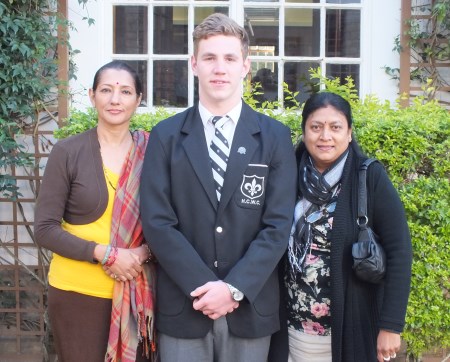 Last term Rob Baldwin, matric pupil at Hilton College, organized T-shirts for the first Hilton/Michaelhouse rugby and hockey fixture to raise funds for charity. Rob handed over a cheque for R30 000 to Ms Seeraj and Ms Govender from Clayton Primary School in Durban at assembly on Tuesday 16 July. This is a wonderful gesture and well done to Rob on a successful venture for charity.
 Put on your takkies & run 10km in aid of Howick Hospice at this year's "Mandela Day Marathon".
 Paul Eaton, owner of
  Recently we shared the story of how two junior school classmates, Maureen Jardim (nee Cunningham) and Olivia Schaffer (nee Getaz), met up after 55 years at a HiltonVillage.co.za networking meeting. We have since followed the story to their reunion with a favourite physical education teacher, Ruth Stevens. This 89 year old is living proof that exercise is good for you and she was delighted that both her 'girls' still kept in shape and were also healthy.
 Congratulations to Mudiwa Llobell who has been selected for the South African u16 Hockey Squad which was selected at the recent Interprovincial tournament. Mudiwa is a Grade 11 pupil at Hilton College who has played for the 1st XI this year.
 It was a grand entrance indeed when Jason Hartman arrived at the
 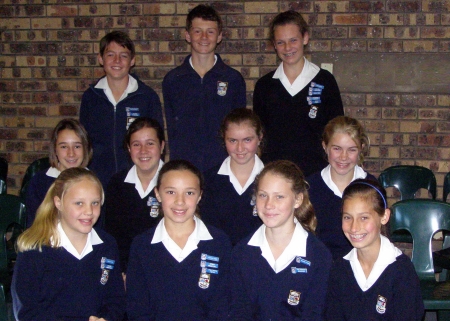 Laddsworth Primary School in Hilton is very proud that 11 pupils in its Grade 7 class of 2013 have won scholarships to prestigious local high schools for the 2014 Grade 8 intake.
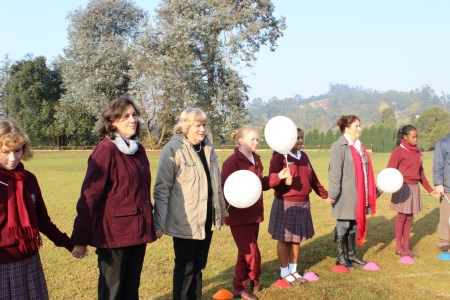 Cowan House formed a giant heart on one of their sports fields today in celebration of Tata Madiba's. Every pupil and teacher stood inside the heart and held hands for 67 seconds in support of #HandsAcrossSA. Children on the border of the heart held up 95 balloons to symbolise Madiba's age. They sang Happy Birthday along with the Soweto Gospel Choir on 5FM.